On our Friday walk around Jamaica Pond, we came across both a plant and a tree in flower. The plant, yellow toadfloax (Linaria vulgaris), has a spike of yellow flowers with orange centers.

Continue reading
On our Friday walk around Jamaica Pond, we came across both a plant and a tree in flower. The plant, yellow toadfloax (Linaria vulgaris), has a spike of yellow flowers with orange centers.
Continue reading
It’s been a rainy June. Boston averages around three and a half inches of rain in June and we have had over ten inches of rain with more to come.
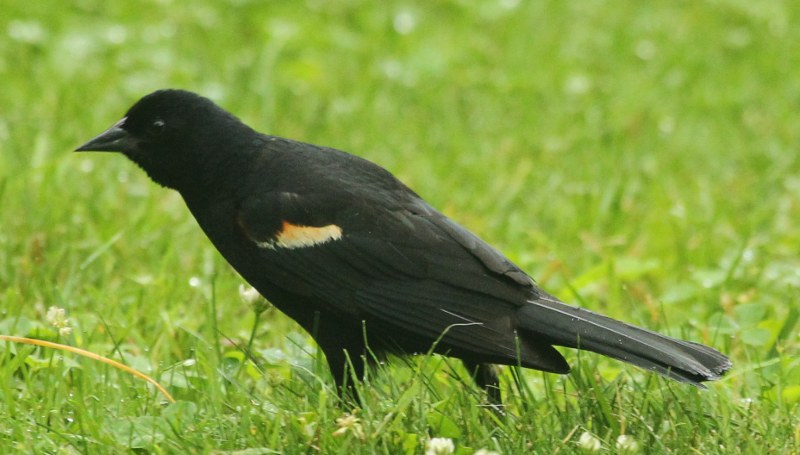
The Muddy River is starting to overflow its banks. I stopped at Willow Pond in Olmsted Park to watch a family of red-winged blackbirds. The male with its red wing-patch (partially covered in the photo below) is the most easily recognizable.
The female looks like a large sparrow with a white, streaked breast.
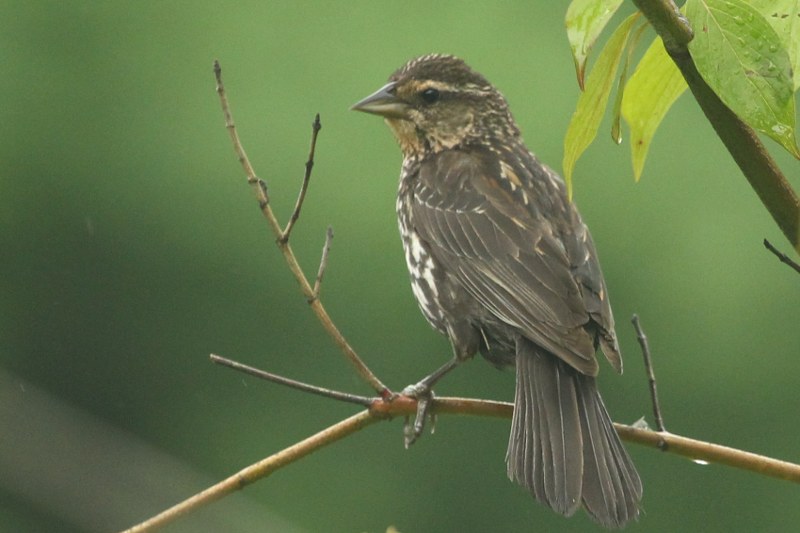
And I saw a juvenile in the same tree as a female.

I took photos of a wealth of natural life at the Arnold Arboretum yesterday. Among the birds, dragonflies, frogs, and plants, only one of the subjects was accessioned: Wilson’s spiraea (Spiraea wilsonii).

I took a walk through Olmsted Park yesterday, a piece of the Emerald Necklace within Jamaica Plain. I saw a mother mallard duck with a dozen ducklings in tow.

Continue reading
The elevated Central Artery running through downtown Boston was dismantled starting in 2004 as part of the Big Dig. The automobile traffic that would have taken the highway now moves below ground. In its place, Boston got the Greenway. On Thursday, I took a tour of the Greenway parks.
The tour was led by Darrah Cole and Anthony Ruggiero, horticulturists working for the Greenway Conservancy, the non-profit group that manages the parks.
Our group started at the Chinatown gate. The park there has reduced green space because the community asked for a plaza where they could hold events. One end of the plaza is lined with Dutch elm-resistant ‘Frontier’ elms. These elms are a hybrid of the European field elm (Ulmus minor) and the Chinese elm (Ulmus parvifolia).

Continue reading
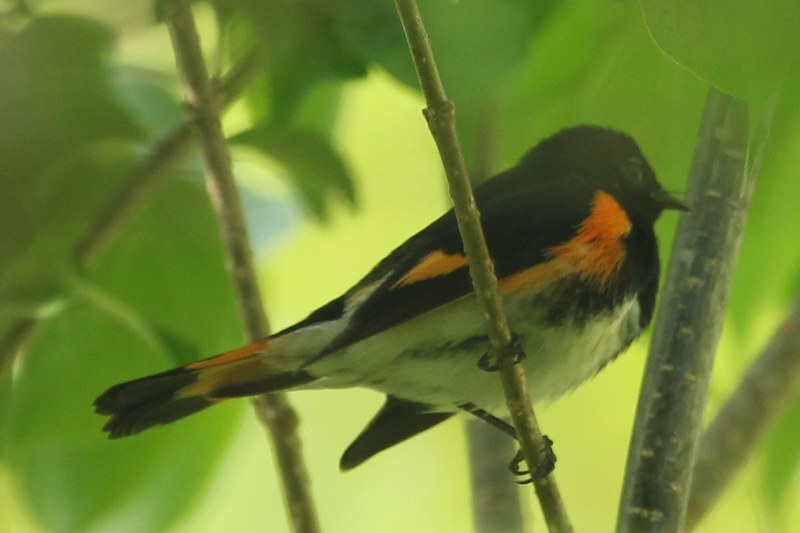
I returned to the Arboretum last Thursday to see if I could pick out a few migrating warblers. I was happy to see four species.
First, the American redstart. These birds spend the winter in the region from southern Mexico and the Caribbean to northeastern South America.
Continue reading
Red-tailed hawks have made their nest near the top of the Maxwell Dworkin building on Harvard University’s campus.

We saw one of the hawks yesterday evening but were unable to see any of the chicks from the ground. However, Harvard SEAS has a webcam for that very purpose.
Susan Moses tells the story of the hawks on Harvard’s Campus Update Nature Watch:
“For many years a pair of red-tailed hawks had nested in a nearby tree. Two years ago, they started a new nest on the Maxwell-Dworkin building, but the female was injured so the nest (and eggs) were abandoned. I tracked her down and found out she was being treated at the Tufts Wildlife Clinic in Grafton. To make a long story short, when she healed I brought her back to Cambridge. She won back her mate who had found another partner when she had ‘disappeared.’ It was too late for them to lay more eggs that year, but last year they built a new nest on Holyoke Center on Mt. Auburn Street. They had two chicks, but I’m not sure what happened to them since I never saw or heard the juveniles once they fledged. This year the pair decided to return to the nest on the Maxwell-Dworkin building and try again.”
A Harvard staff member kept a blog on the hawks in 2010.
A thank-you to Ernest for the tip.
I had been hearing reports of a nesting pair of great horned owls and two owlets at Forest Hills Cemetery. I went by the cemetery yesterday to see if I could find any of them.
I found one of the owls high up in a hemlock tree. Since I couldn’t see any feather tufts on its head, I suspect this is one of the juveniles, although its size is already intimidating.

Thanks to arbotopia for the tip.
The birds in the Arnold Arboretum are now in the thick of spring. On a cool, sunny morning, I watched them build nests, sing to attract mates, and defend their territory.

Continue reading
Yesterday was the last in a long streak of sunny and dry days in Boston. I visited Forest Hills Cemetery to see what I could find.
I saw this eastern forktail damselfly resting on a reed at the edge of Lake Hibiscus. Damselflies rest with their wings closed or only slightly open. According to A Field Guide to the Dragonflies and Damselflies of Massachusetts, eastern forktails emerge early in the spring and are very common in this area.

Continue reading