Boston’s Naked Bike Ride passed by me near the Public Garden last night. About 75 people in various states of undress, some completely nude, rode their bicycles as part of a protest:
“By riding in the WNBR we face automobile traffic with our naked bodies as the best way of defending our dignity and exposing the unique dangers faced by cyclists and pedestrians as well as the negative consequences we all face due to dependence on oil, and other forms of non-renewable energy.” – ride facebook page
It’s been a rainy June. Boston averages around three and a half inches of rain in June and we have had over ten inches of rain with more to come.
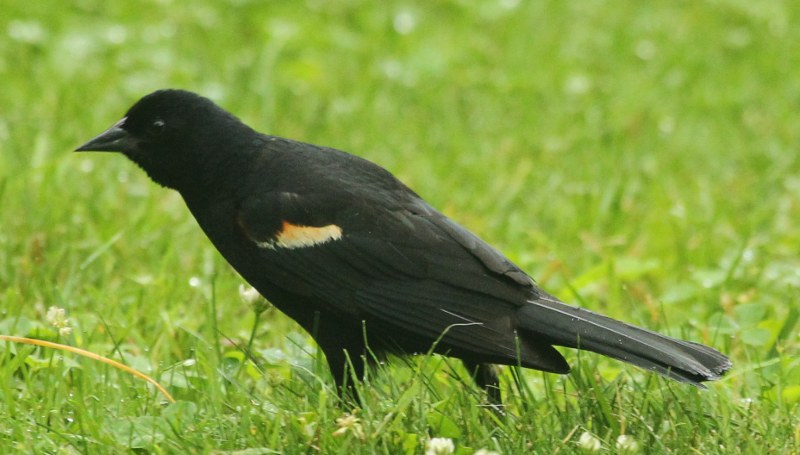
The Muddy River is starting to overflow its banks. I stopped at Willow Pond in Olmsted Park to watch a family of red-winged blackbirds. The male with its red wing-patch (partially covered in the photo below) is the most easily recognizable.
Male red-winged blackbird
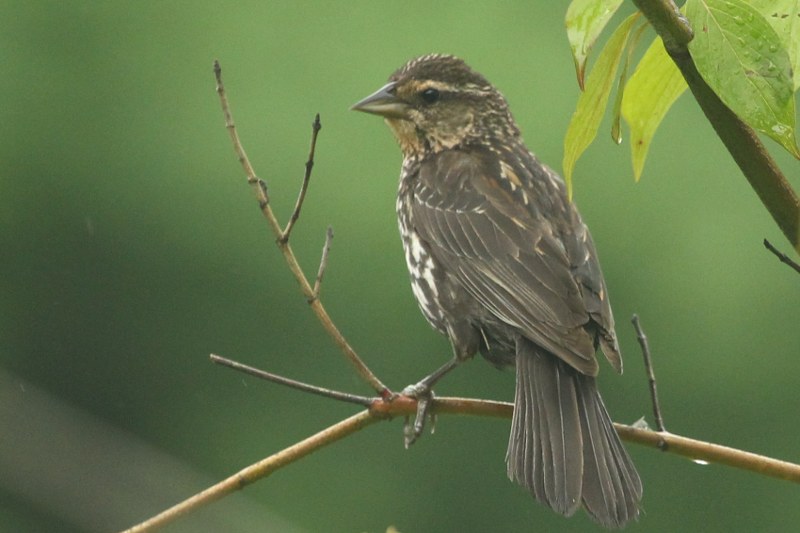
The female looks like a large sparrow with a white, streaked breast.
Female red-winged blackbird
And I saw a juvenile in the same tree as a female.
Strong thunderstorms passed through Jamaica Plain this evening, leaving this wonderful double rainbow in their wake.
Look closely at the bottom rainbow and you’ll see that some of the colors repeat on the lower end. This makes it a supernumerary rainbow, the physics of which I won’t pretend to understand.
And, of course, this post is not complete without paying homage to double rainbow guy.
June heralds the blooming of lupines in New Hampshire, and we headed up to Sugar Hill for the 20th Annual Fields of Lupine Festival. The two-week-long festival features parades, open houses, markets, and concerts, but none of these events were scheduled on the day of our visit.
We first stopped at Polly’s Pancake Parlor for a delicious brunch. I, of course, marvelled at the red oak just outside the restaurant that had been planted by Lucy Hildreth and Wilfred Dexter on their wedding day, the 24th of May, 1899. Over a hundred years old, this oak still stands strong. Continue reading →
I took photos of a wealth of natural life at the Arnold Arboretum yesterday. Among the birds, dragonflies, frogs, and plants, only one of the subjects was accessioned: Wilson’s spiraea (Spiraea wilsonii).
I took a walk through Olmsted Park yesterday, a piece of the Emerald Necklace within Jamaica Plain. I saw a mother mallard duck with a dozen ducklings in tow.
A mother mallard duck with some of her dozen ducklings Continue reading →
This afternoon, a living memorial to one of the more famous victims of the Holocaust was planted on Boston Common. Anne Frank, author of The Diary of a Young Girl, which chronicles her time in hiding from the Nazis, mentioned a horse chestnut tree that grew just outside the window of the Secret Annex where she was hiding.
“Nearly every morning I go to the attic to blow the stuffy air out of my lungs. From my favorite spot on the floor, I look up at the blue sky and the bare chestnut tree, on whose branches little raindrops shine, appearing like silver, and at the seagulls and other birds as they glide on the wind…”
“The best remedy for those who are frightened, lonely or unhappy is to go outside, somewhere they can be alone, alone with the sky, nature and God. For then and only then can you feel that everything is as it should be and that God wants people to be happy amid nature’s beauty and simplicity. As long as this exists, and that should be forever, I know there will be solace for every sorrow, whatever the circumstances. I firmly believe that nature can bring comfort to all who suffer.”
This black locust tree is part of a large stand southwest of the Prospect Hill Monument in Somerville’s Prospect Hill Park. The Boston skyline, including the Prudential building, can be seen in the background.
Black locust trees (Robinia pseudoacacia) are an invasive species in Massachusetts, but it is difficult to dislike them this time of year, when the trees perfume the air with a jasmine-like scent. The trees can no longer be legally planted. Older trees can be found in yards, but most of these trees grow in minimally-maintained spaces.
The elevated Central Artery running through downtown Boston was dismantled starting in 2004 as part of the Big Dig. The automobile traffic that would have taken the highway now moves below ground. In its place, Boston got the Greenway. On Thursday, I took a tour of the Greenway parks.
The tour was led by Darrah Cole and Anthony Ruggiero, horticulturists working for the Greenway Conservancy, the non-profit group that manages the parks.
Our group started at the Chinatown gate. The park there has reduced green space because the community asked for a plaza where they could hold events. One end of the plaza is lined with Dutch elm-resistant ‘Frontier’ elms. These elms are a hybrid of the European field elm (Ulmus minor) and the Chinese elm (Ulmus parvifolia).