It is easy to miss maple flowers, especially on large trees. From a distance, the branches appear to blush and that is all. Look closely and you’ll see a profusion of anthers leaping out of short, red petals.

Continue reading
It is easy to miss maple flowers, especially on large trees. From a distance, the branches appear to blush and that is all. Look closely and you’ll see a profusion of anthers leaping out of short, red petals.
Continue reading
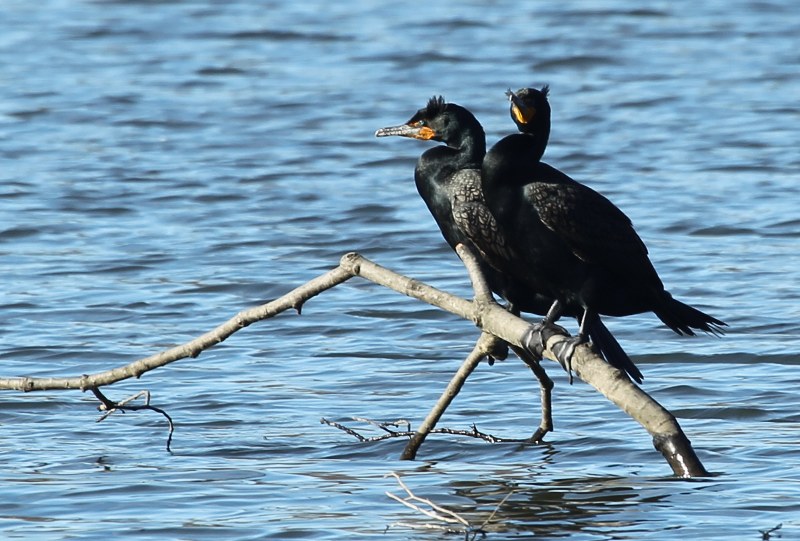
I saw two birds for the first time yesterday. First, a pair of double-crested cormorants were lounging in the middle of Leverett Pond, black but for their orange chins.
Continue reading
Jamaica Pond is finally ice-free! The wind coming off the water yesterday, however, did not feel like it. We took a walk as the sun set.
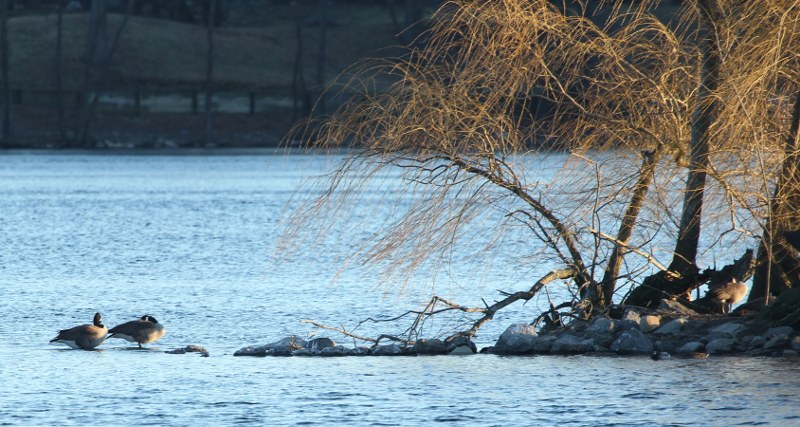
American coots were diving for vegetation and then squabbling once a coot was successful at obtaining some. It’s late in the year for the coots, which should leave for their summer breeding grounds in the Upper Midwest and Canada any day now.
I saw two species of birds for the first time on Monday, while walking around the Chestnut Hill Reservoir. First, the ruddy ducks, traveling in a large flock, some of them with their tails up in the air.

And then two golden-crowned kinglets, tiny blimp-like birds with no necks. I was able to approach them fairly close as they danced around and through the branches of shrubs.

With snow on the ground and a chill in the air, Saturday did not feel like spring. But the birds at the Arnold Arboretum were singing their spring songs. We found large concentrations of birds near the Visitor Center and around Faxon Pond.
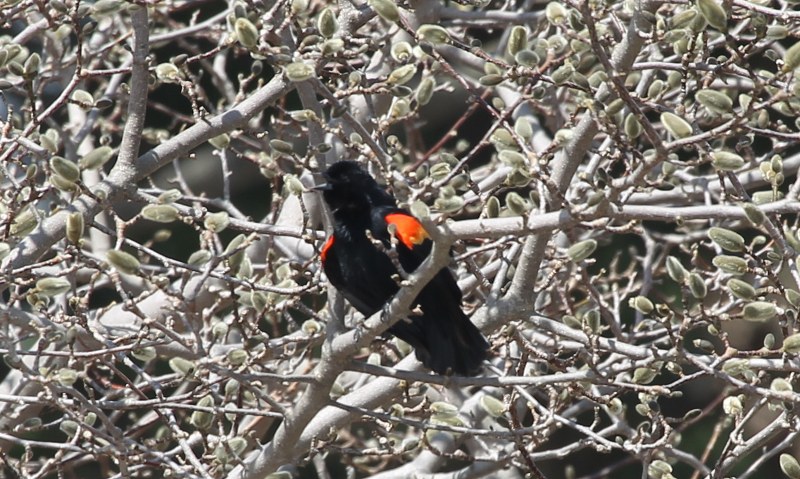
The red-winged blackbirds, all males as far as we could tell, were singing loudly. Common grackles, another sign of spring, checked us out with those freakishly white eyes of theirs.

Continue reading
Next to the Hunnewell building, a shrub has been blooming bright yellow for quite a while now. Refusing to wait for spring, certain species of witch-hazel unfurl their petals as early as January. ‘Arnold Promise’ has a little more patience, waiting until the middle of February.

This past Wednesday, the Arnold Arboretum’s Nancy Rose shared the story of the plant’s origin. In 1928, William Judd collected seeds from a Chinese witch-hazel (Hamamelis mollis) growing in the Arboretum. Seven plants survived the germination process but none were like its parent. Judd deduced that the plants were a cross with the Japanese witch-hazel (Hamamelis japonica) planted nearby. The best of these plants, one that did not hold onto its dead leaves and whose flowers had long, bright yellow petals, was named ‘Arnold Promise.’

Arnoldia article on ‘Arnold Promise’ (pdf)
On Sunday, I joined an Urban Nature Walk in the Arnold Arboretum led by Jef. Last year at this time, a few magnolias, cherries, and red maples were blooming. This year, winter still held sway with temperatures in the 30s F, a cold wind, and patches of snow hiding in shadow.
Despite the cold, we found a few plants in flower. Skunk cabbages (Symplocarpus foetidus) were popping up near the marsh.

The rosegold pussy willow (Salix gracilistyla), native to East Asia, was also starting to bloom.

Continue reading
Cold and windy, yesterday was not the best day to visit the Boston Public Garden. But the sky was clear, and visitors were sliding along the ice on the lagoon.
A few birds were out. The usual suspects such as the rock pigeons, starlings, robins, and house sparrows. But I also managed to see a blue jay and this red-tailed hawk.

The blue jay was flitting about on a weeping willow that had a hole running clear through one of its branches. I wonder what creature made that happen.

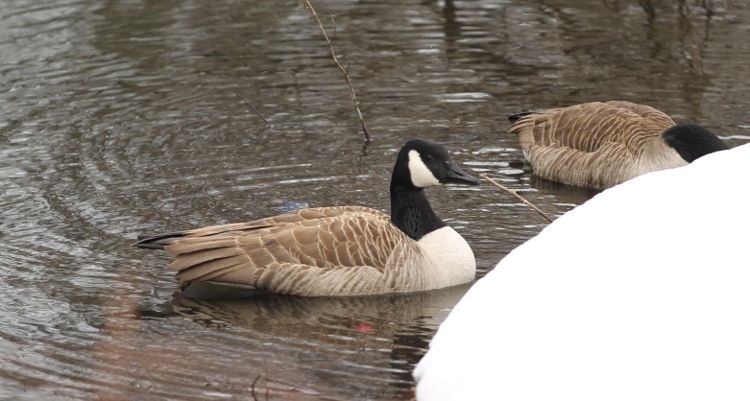
A light snow fell as I walked through Olmsted Park. I didn’t see a single bird in Ward’s Pond. It wasn’t until Willow Pond that I ran into the Canada geese.

Continue reading
Can mute swans walk on ice? Apparently not very well…

