Category Archives: Nature

Anne Frank Sapling Planted on Boston Common

This afternoon, a living memorial to one of the more famous victims of the Holocaust was planted on Boston Common. Anne Frank, author of The Diary of a Young Girl, which chronicles her time in hiding from the Nazis, mentioned a horse chestnut tree that grew just outside the window of the Secret Annex where she was hiding.

“Nearly every morning I go to the attic to blow the stuffy air out of my lungs. From my favorite spot on the floor, I look up at the blue sky and the bare chestnut tree, on whose branches little raindrops shine, appearing like silver, and at the seagulls and other birds as they glide on the wind…”

“The best remedy for those who are frightened, lonely or unhappy is to go outside, somewhere they can be alone, alone with the sky, nature and God. For then and only then can you feel that everything is as it should be and that God wants people to be happy amid nature’s beauty and simplicity. As long as this exists, and that should be forever, I know there will be solace for every sorrow, whatever the circumstances. I firmly believe that nature can bring comfort to all who suffer.”

Horse chestnut sapling planted
Horse chestnut sapling from the Anne Frank tree

Continue reading

Posted in Culture, Nature | Tagged , , , , , , | Comments Off on Anne Frank Sapling Planted on Boston Common

Black Locust Trees of JP

Black locust trees (Robinia pseudoacacia) are an invasive species in Massachusetts, but it is difficult to dislike them this time of year, when the trees perfume the air with a jasmine-like scent. The trees can no longer be legally planted. Older trees can be found in yards, but most of these trees grow in minimally-maintained spaces.

Black Locust flowers: white
Black Locust flowers

Continue reading

Posted in Nature | Tagged , , , , | Comments Off on Black Locust Trees of JP

Tour of the Rose Kennedy Greenway

The elevated Central Artery running through downtown Boston was dismantled starting in 2004 as part of the Big Dig. The automobile traffic that would have taken the highway now moves below ground. In its place, Boston got the Greenway. On Thursday, I took a tour of the Greenway parks.

The tour was led by Darrah Cole and Anthony Ruggiero, horticulturists working for the Greenway Conservancy, the non-profit group that manages the parks.

Our group started at the Chinatown gate. The park there has reduced green space because the community asked for a plaza where they could hold events. One end of the plaza is lined with Dutch elm-resistant ‘Frontier’ elms. These elms are a hybrid of the European field elm (Ulmus minor) and the Chinese elm (Ulmus parvifolia).

Frontier elms on Chinatown plaza

Continue reading

Posted in Culture, Nature | Tagged , , , , , , , , , , , , , , , , , , , , , , , , , , | Comments Off on Tour of the Rose Kennedy Greenway

Arboretum: Warblers and Trillium

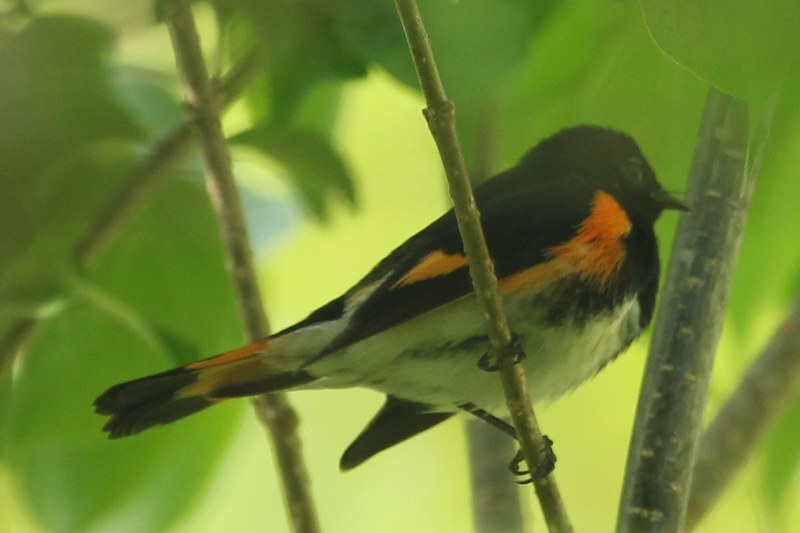
I returned to the Arboretum last Thursday to see if I could pick out a few migrating warblers. I was happy to see four species.

First, the American redstart. These birds spend the winter in the region from southern Mexico and the Caribbean to northeastern South America.

American redstart
American redstart

Continue reading

Posted in Nature | Tagged , , , , , , , , , , , , , | Comments Off on Arboretum: Warblers and Trillium

Red-tailed Hawks at Harvard

Red-tailed hawks have made their nest near the top of the Maxwell Dworkin building on Harvard University’s campus.

Red-tailed hawk by its nest
A red-tailed hawk guards its nest on the Maxwell Dworkin building.

We saw one of the hawks yesterday evening but were unable to see any of the chicks from the ground. However, Harvard SEAS has a webcam for that very purpose.

Susan Moses tells the story of the hawks on Harvard’s Campus Update Nature Watch:

“For many years a pair of red-tailed hawks had nested in a nearby tree. Two years ago, they started a new nest on the Maxwell-Dworkin building, but the female was injured so the nest (and eggs) were abandoned. I tracked her down and found out she was being treated at the Tufts Wildlife Clinic in Grafton. To make a long story short, when she healed I brought her back to Cambridge. She won back her mate who had found another partner when she had ‘disappeared.’ It was too late for them to lay more eggs that year, but last year they built a new nest on Holyoke Center on Mt. Auburn Street. They had two chicks, but I’m not sure what happened to them since I never saw or heard the juveniles once they fledged. This year the pair decided to return to the nest on the Maxwell-Dworkin building and try again.”

A Harvard staff member kept a blog on the hawks in 2010.

A thank-you to Ernest for the tip.

Posted in Nature | Tagged , , , , | Comments Off on Red-tailed Hawks at Harvard

Arboretum Tree Mob: Eastern Redbud

For populations to evolve, mutations are necessary. These changes in the genetic code often go unnoticed but, when they do affect the plant’s development, horticulturists select for the ones that make plants more productive or pleasing to people. In Tuesday’s tree mob, the Director of the Arnold Arboretum Ned Friedman spoke to us about a clearly visible mutation in an eastern redbud tree close to the katsura collection (accession #10-68*B).

Ned Friedman pointing to a mutation in an eastern redbud tree
Ned Friedman speaking on a mutation in an eastern redbud tree

Friedman first introduced the botanical term “cauliflory,” a reference to plants that flower from old growth. Redbud is one of these plants. See the photo below for flower buds on the trunk of the tree.

Eastern redbud flower bud on trunk
Eastern redbud flower bud on the trunk

Friedman then pointed out that one branch of the redbud tree had white flowers, in contrast to the reddish-purple flowers on the rest of the tree. Because eastern redbud flowers on old growth, he was able to pinpoint the location on the branch where the mutation knocking out the anthocyanin pigment in the flowers must have occurred. He guessed that the mutation occurred between ten and twelve years ago.

white and reddish-purple flowers on the same eastern redbud branch
The point on the branch where the reddish-purple flowers turn to white flowers

Friedman said that the mutation exists in every cell from that point on the branch onward and, as long as the flowers don’t cross-pollinate with reddish-purple flowers, will be seen in any plants grown from the seeds that develop on the branch.

This tree mob was the first in a series of three tree mobs that Friedman will lead on mutations in plants.

Update: “Mutants in Our Midst” article (pdf) on Arnoldia

Posted in Nature | Tagged , , , , , , | Comments Off on Arboretum Tree Mob: Eastern Redbud

Great Horned Owl at Forest Hills

I had been hearing reports of a nesting pair of great horned owls and two owlets at Forest Hills Cemetery. I went by the cemetery yesterday to see if I could find any of them.

I found one of the owls high up in a hemlock tree. Since I couldn’t see any feather tufts on its head, I suspect this is one of the juveniles, although its size is already intimidating.

Great horned owl resting on a hemlock branch

Thanks to arbotopia for the tip.

Posted in Nature | Tagged , , , , | Comments Off on Great Horned Owl at Forest Hills

Arboretum: Nests and Hummingbirds

The birds in the Arnold Arboretum are now in the thick of spring. On a cool, sunny morning, I watched them build nests, sing to attract mates, and defend their territory.

Female red-winged blackbird holding straw in her beak
A female red-winged blackbird finds material for her nest

Continue reading

Posted in Nature | Tagged , , , , , , , , , , , , , , | Comments Off on Arboretum: Nests and Hummingbirds

Forest Hills Cemetery on a Spring Day

Yesterday was the last in a long streak of sunny and dry days in Boston. I visited Forest Hills Cemetery to see what I could find.

I saw this eastern forktail damselfly resting on a reed at the edge of Lake Hibiscus. Damselflies rest with their wings closed or only slightly open. According to A Field Guide to the Dragonflies and Damselflies of Massachusetts, eastern forktails emerge early in the spring and are very common in this area.

Eastern Forktail Damselfly resting
Eastern Forktail Damselfly

Continue reading

Posted in Nature | Tagged , , , , , , , , , , , , , , , , , , , , | Comments Off on Forest Hills Cemetery on a Spring Day